Chores and points, with rewards that are time with you.
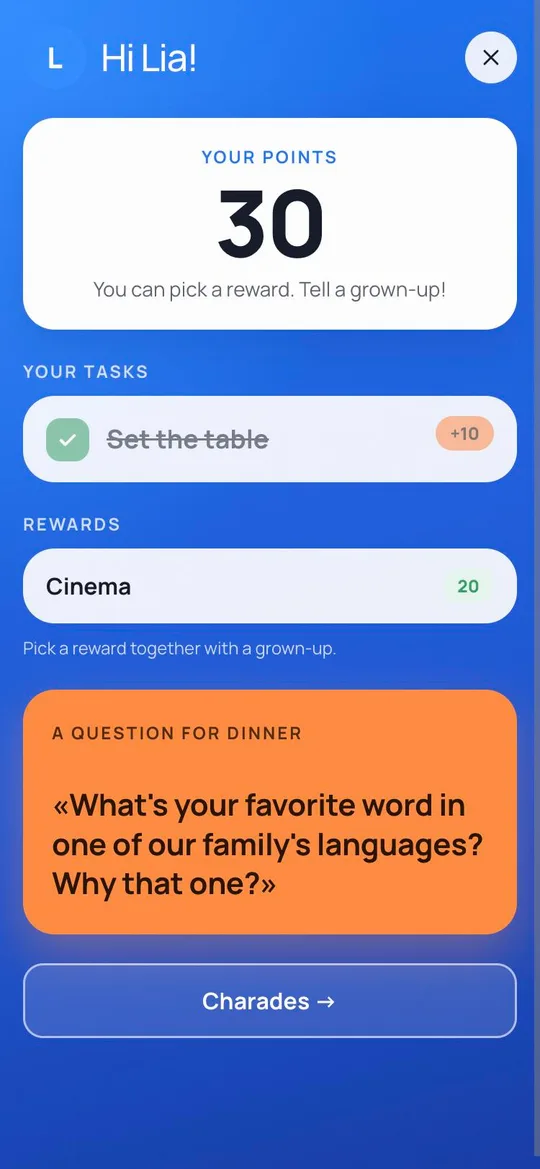
Set the table, 10 points. Screens off on time without a fuss, 15. Cook dinner for everyone, 30. The kids choose the chores with you, check them off in their own mode, and spend the points on things like picking the car music for a week. Not on stuff.
How it works
You pick chores with each child from a list or write your own, each with a points value. Brush teeth without being asked, 5. Set the table, 10. Read 20 minutes, 10. Empty the dishwasher, 15. Say something kind to everyone at home, 10. The child checks them off in kids' mode and sees the points grow.
Rewards are time, not things
The rewards list is built the same way, together: you pick the car music for a week, 35 points. You pick dinner one evening, 50. An hour just you and a parent, your plan, 100. Build a blanket fort and sleep in it, 120. A bike ride with a parent, you pick where, 150. The point of the points is a plan for time together.
Teenagers: points off
Points and chores can be switched off per child. A nine-year-old likes the chart; a fourteen-year-old gets tasks without stickers and keeps their own check and the cards for ages 12 to 17.
Kids' mode
Hand over your phone, or give the child their own access: a link from the Family screen opens kids' mode on their own phone, with no password and nothing else of the family. The child sees their tasks, points, rewards, tonight's question card, a game and their own check. On your phone a family PIN brings you back. Children never see the handover, your chats with Mila or the other adults' answers.
What it costs
Points and chores are free for all children, and every child can redeem one reward a month. Plus, $4.99 a month per family, redeems without limit. Honest note: during the beta, Plus is free for beta families until February 2027.
Questions parents ask about points
Isn't paying kids for chores a bad idea?
Paying with money often is. Here the currency is time with you, and the chores are chosen together. Many families use the chart for a few months until the routine holds, then switch it off.
What if one child wants points and the other doesn't?
Switch it per child. One can run the chart, the other gets plain tasks.
Can both parents and the grandparents give points?
Yes, every adult in the family can tick tasks and give points. In two households, both homes see the same balance.
Start with the free check
Parents also ask
How much allowance is normal at seven?
Less than you think, and more regularly than you think. A small, fixed amount every week, paid on the same day whether the room was tidy or not, teaches more than a larger sum that depends on your mood. The amount matters less than the rule: it's theirs, they can waste it, and you don't top it up.
Every evening is a battle over homework. Is that normal?
Very normal, and very tiring. Most homework fights aren't about the homework. They're about a tired child, a tired parent and a task nobody chose. Change the setup, not the child.
How do I explain money to my 7-year-old? Is it too early?
Not too early at all. Seven is a good age: they can count, they want things, and they're starting to notice that things cost. You don't need a lecture. You need coins, a jar and the supermarket.