Co-parenting across two homes, without the Sunday-night text thread.
Alternating weeks, two kitchens, one child who needs the same bedtime in both. TrustParent gives both parents the same plan, the same calendar and a handover that replaces the Word file and the long voice message. Free, for both of you.
The handover
When the kids change households, one parent writes the handover: six short sections, health, school, sport, money and things, reading, other. Each point gets a status and a reply from the other parent. Whatever stays open carries over into the next handover, so nothing gets lost between a Friday and a Monday.
It's a note, not a chat. No typing indicators, no read receipts, no pressure to answer at 10 pm. Both of you see the history.
A weekly plan that knows week A and week B
The weekly plan is a routine per child: homework, reading, sport, screen time, bedtime. It knows week A and week B, so alternating weeks between two homes don't need a second plan. Each slot gets a check mark when it's done, and points if you want them.
Both parents see the same plan. If the other home does bedtime differently, you see that too, and you can talk about it with a plan in front of you instead of a feeling.
One calendar, in your own calendar app
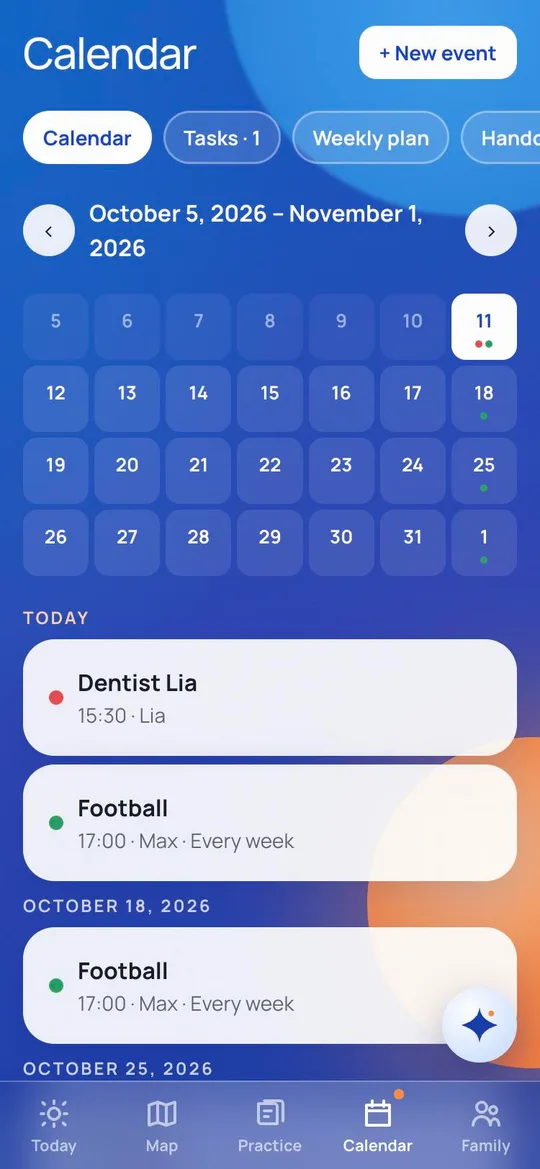
Family events, tasks and the weekly plan live in one calendar both parents see. You can subscribe to it in Google, Apple or Outlook, so it sits next to your work calendar.
Honest note: the subscription is read-only today. Changes are made in TrustParent. Two-way sync is on the list.
Who sees what
Up to five adults can join a family at no extra cost: both parents, a new partner, a grandparent, the nanny. Every adult sees the calendar, the tasks, the weekly plan and the handover. Nobody sees another adult's check answers or chats with Mila. Different languages in the two homes? Each parent picks their own; the cards and the plan come in that language.
What it costs
The calendar, the weekly plan, the handover, tasks and points are free, for both parents, in both homes. Plus, $4.99 a month per family, opens the whole Parenting Map, all cards, games and practices and Mila without a daily limit. One Plus covers both households.
Questions separated parents ask
Does the other parent need their own subscription?
No. Plus is per family. The other parent joins with a link and pays nothing extra, in the other home, even in another language.
Can I export the handovers, for a mediator or a lawyer?
Not yet. The history is visible in the app for both parents. A PDF export with timestamps is on the list; write to us if you need it sooner.
Does it work if we don't get along?
That's what it's built for. The handover is structured and short, there is no chat, and the plan is the same on both phones. It takes the tone out of the logistics.
What do the kids see?
Only their own tasks, points and rewards, in kids' mode, on a parent's phone or on their own. Never the handover.
Start with the free check
Parents also ask
Since the separation our child moves between two homes and is unsettled. Is that normal?
Yes. Changing homes every few days is work for a child, and the first months are the hardest: tears at the handover, a wild evening after, a baby-like clinginess that was gone. Children settle when the two homes agree on a few things, the handover is calm, and nobody has to be a messenger.
I yell at my child and then feel terribly guilty. Is that normal?
Yes. Almost every parent yells sometimes, and the guilt afterwards means you care. One shout doesn't break a child. What matters is what happens next, and how often it happens.
My 12-year-old answers every question with "fine." Is that normal?
Completely normal, and not a sign that the door is closed for good. At twelve, "fine" mostly means "I'm building a room of my own, and I'm tired." The way in is sideways, not head-on.